Showing up
Tags & shared proofs
You went for the run together, but only one of you photographed it. A tag puts the other person's name on that photo. It is a mention and nothing else — it hands them no credit, asks them for no answer, and they can take it back off whenever they like.
At a glance
- Two ways in — pick names in the composer as you post, or add them to a proof that is already up.
- Anyone in the group can be tagged, whether or not they are running the season.
- There is nothing to accept. A tag is live the moment it is written; the tagged member is told, not asked.
- It counts for nobody but the author. The proof is theirs — the streak, the completion and the ranking with it. A tag moves none of those for the person tagged.
- Being tagged does put you in the conversation. Likes and comments on that proof reach you for as long as you are in the group.
- Either side can undo it. The author can untag; the tagged member can untag themselves, on any screen, in any season, ended or not.
- Removal is silent and leaves no record — which also means nothing stops the author tagging you again.
Tagging as you post
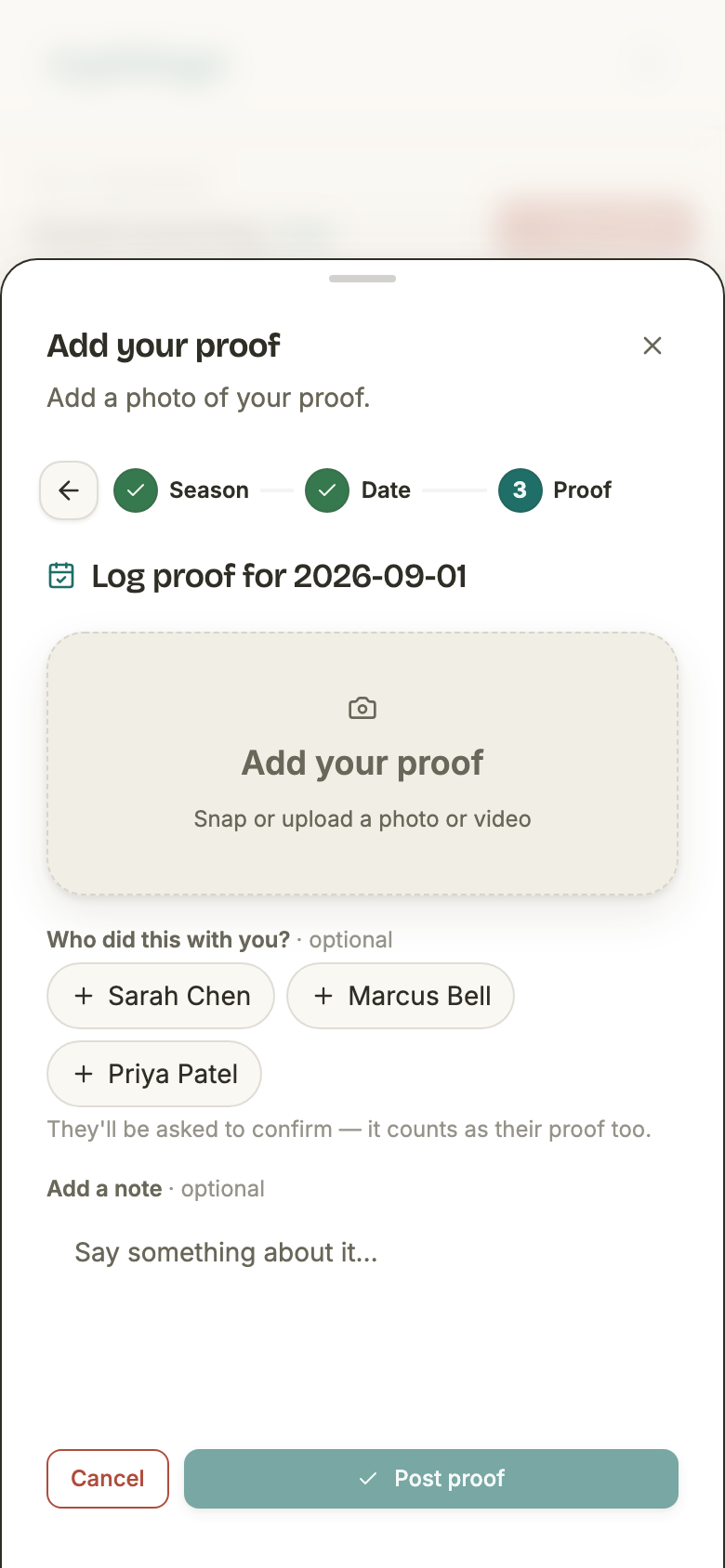
The composer's last question before the caption is Who did this with you? It is optional, and it lists every other member of the group — not of the season, and not only the ones with a commitment. Tapping a name selects it; the tags are written in the same database transaction as the proof itself, so a proof never exists for a moment without the names on it.
Tagging afterwards
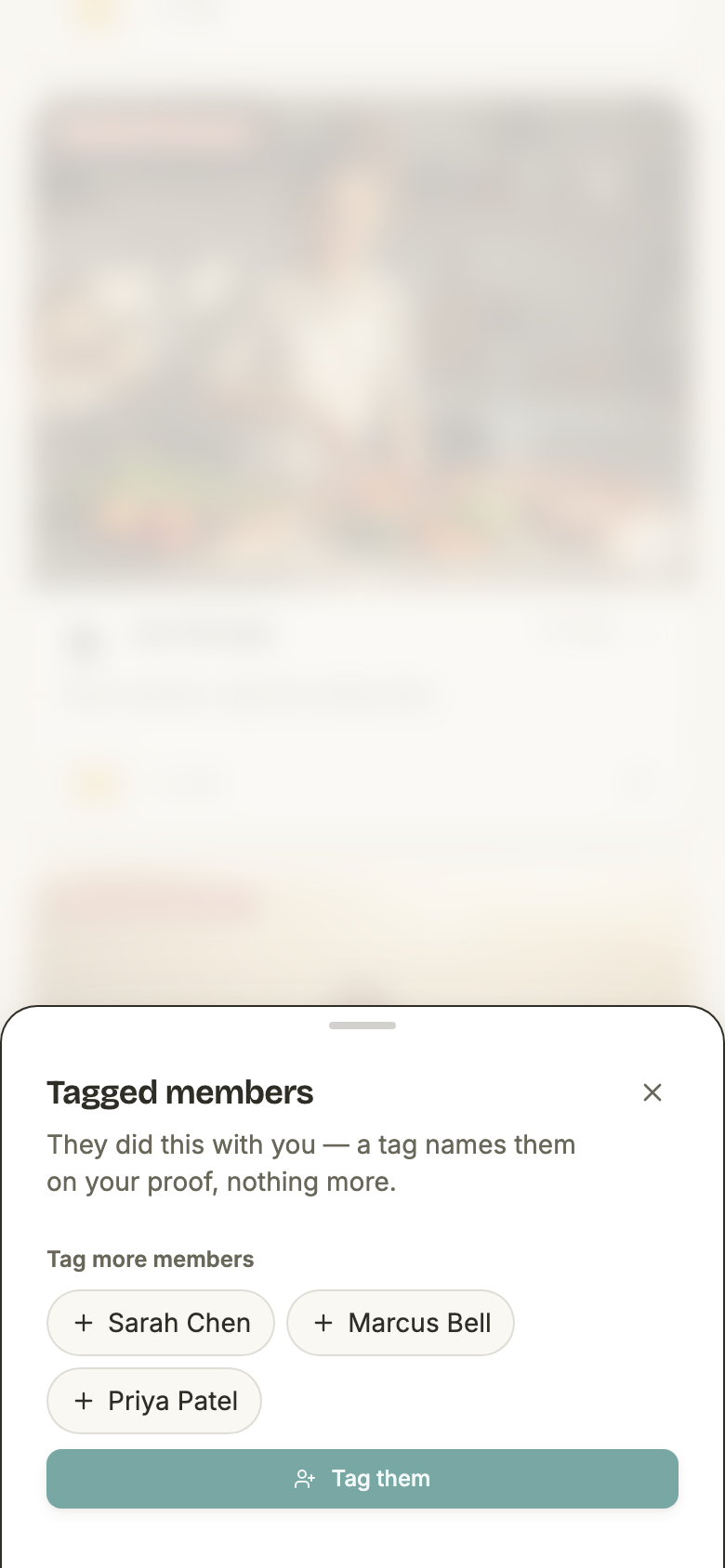
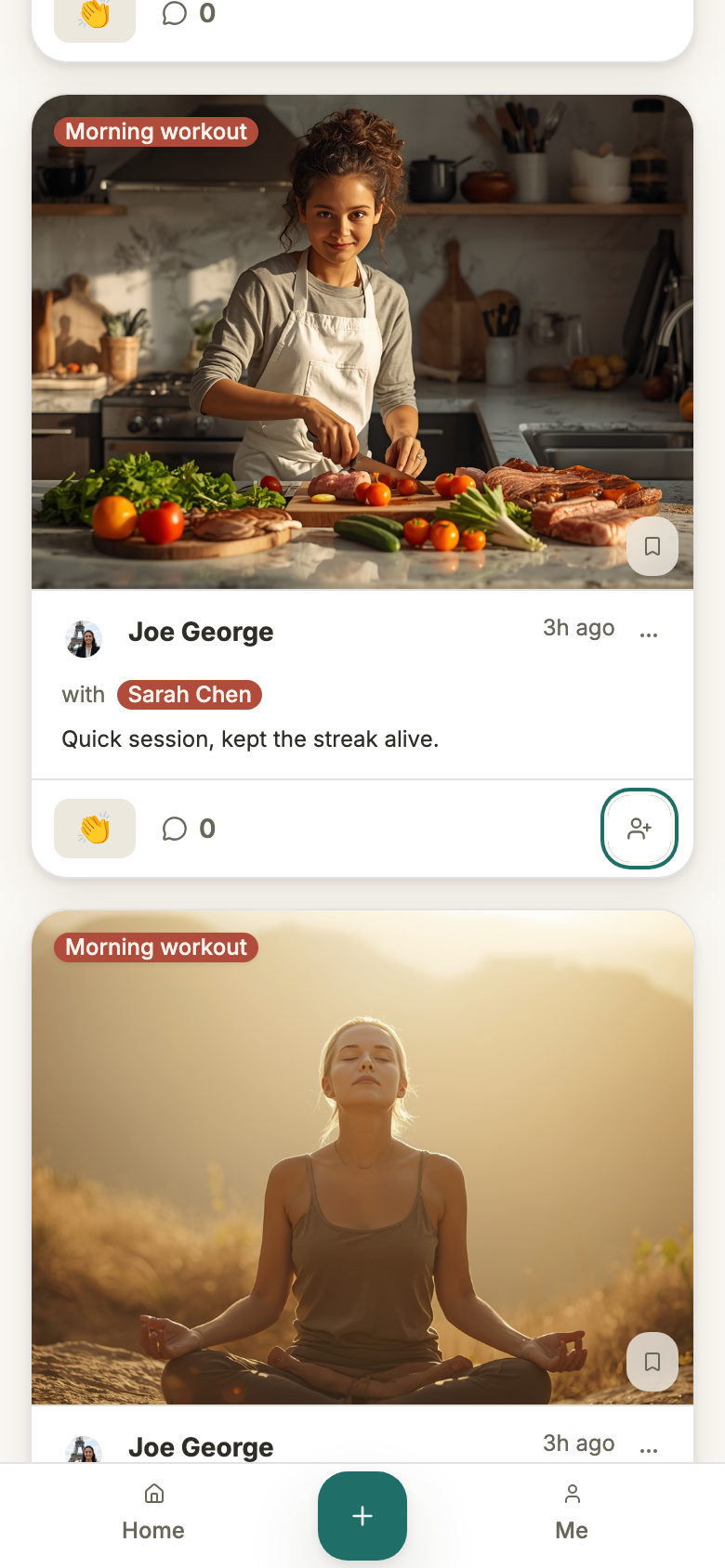
The other path is the one people actually use — the photo went up and you remembered the tag after. On your own card, the person-plus button opens Tagged members: who is on the proof already, and chips for everyone who is not.
- Who may add
- The proof’s author, and only them. Anyone else is refused — “Only the author can manage this proof’s tags”.
- Who may be added
- Any live member of the proof’s group except yourself. A commitment in the season is not required — the tag names them, it does not enrol them.
- How many
- Up to twenty in one request, both when posting and afterwards. Nothing caps the total on a proof.
- Already tagged
- 409 — “That member is already tagged on this proof”. The whole request is refused, not just that name.
- Tagging yourself
- 400 — “You cannot tag yourself”. Naming the same person twice in one request is refused the same way.
- Somebody outside the group
- 400 — “Tagged members must be in this group”. Membership is checked at the moment of the write, so a member who has left is no longer taggable.
- After the season ends
- 409 — “The season has ended”. Adding a tag is an edit to your proof, and edits stop when the season does.
- While withdrawn
- 409 — “A withdrawn commitment cannot edit proof”. Resume first, exactly as for editing the caption.
There is no accept, and no decline
A tag used to be an invitation. The tagged member accepted or declined it, and accepting minted them a real proof of their own — the author's photo, in their column, feeding their streak. That is gone. A tag is now auto-accepted on write: there is no pending state, no decision to make, and no way to refuse one other than taking it back off afterwards.
The decision behind that is recorded as ADR-0024, and its reasoning is short: compliance is a claim about what you did, and no amount of consent from either side makes another member's photo into your day. The old flow did not merely hand over credit — it spent your slot, because one proof per due day is a hard rule and the copy occupied it. Somebody else's tap could take a day away from you.
What a tagged proof counts for
One proof, one owner. Everything the product scores is scored against the member who wrote it, and the tag changes none of it.
- For the author
- Everything, unchanged. It fills their due day, moves their completion, extends their streak and counts against their weekly quota — exactly as an untagged proof would.
- For the tagged member
- Nothing that scores. No day is filled, no streak moves, no completion changes, and their calendar does not gain an entry. Their board row reads the same before and after.
- What they do get
- Their name on the card, a bell row, a push, an email — and standing in the conversation on that proof.
- On the feed
- One card. The proof appears once, under its author, with a “with …” row beneath the name.
- Likes and comments
- Reach the author and every tagged member, minus whoever wrote them. Being named is what makes you part of the thread.
- If they leave the group
- Their name stays on the card and the notifications stop. Participation is written once; reachability is asked again on every reaction.
What the tagged member is told
Three channels, one event, all of them fired after the tag is safely written — none of them can make a tag fail.
- The bell
- “<name> tagged you in a proof”, with an @ badge. It opens the proof’s own page — which is also where the name can be taken back off. Untagging deletes this row with the tag.
- Push
- Same sentence. Opens the same page.
- Subject “<name> tagged you in a proof”, with an Open the proof button.
- How often
- Once ever, per member, per proof — across all three. The dedupe is keyed to the proof’s own date, which never moves, so untagging and re-tagging the same person never notifies them a second time.
- Never sent
- Nothing at all is sent when a tag is removed, by either side.
The email's full entry — who it goes to, what it says and how the unsubscribe works — is in the Email notifications guide, and its phone twin is in Push notifications .
Taking a name back off
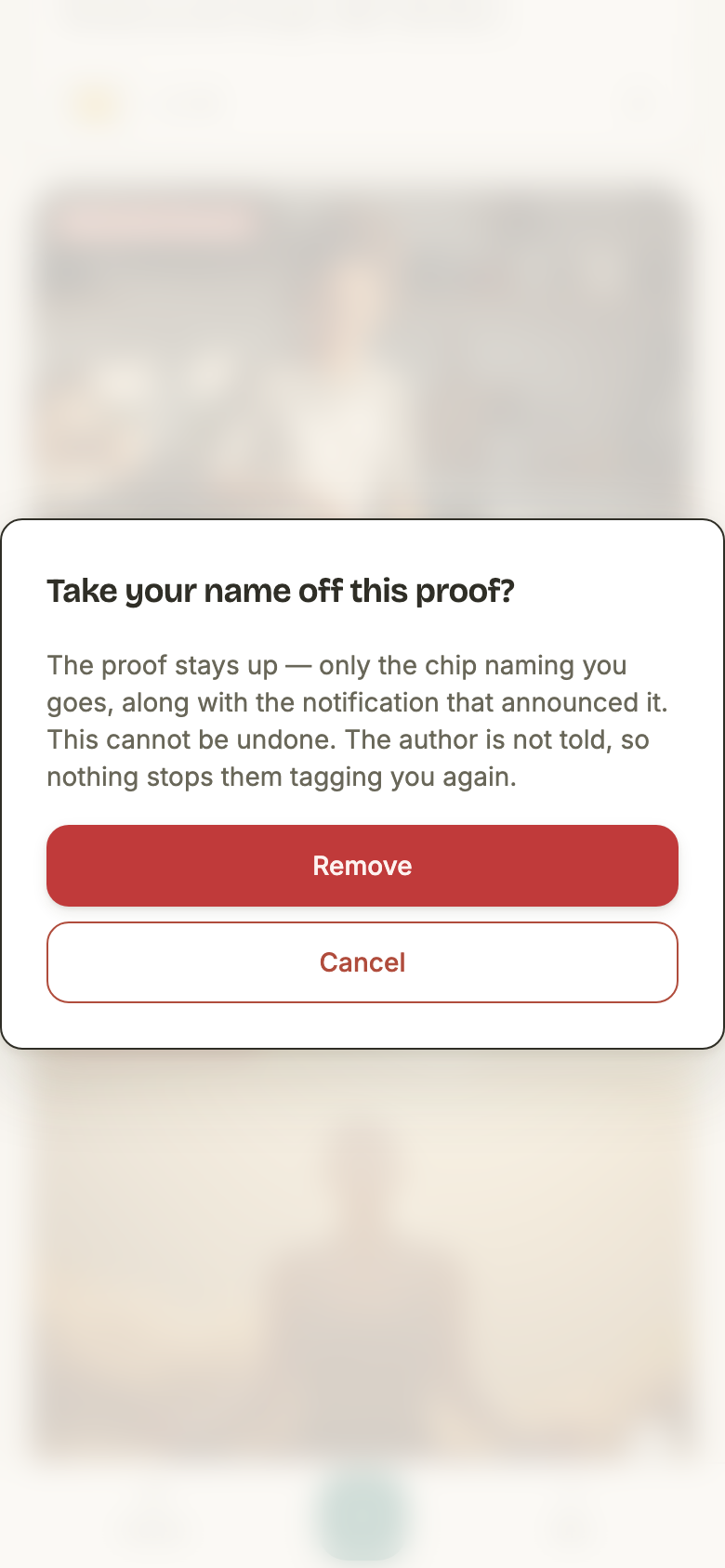
One route serves both sides. The author removes a name from the Tagged members sheet; the tagged member taps the × on their own chip, wherever they meet it. The chip carries that × on every surface in the product, including ones where the author's own controls are withheld, because taking your name off a photo of yourself is not a permission a screen grants.
- Who may remove
- The proof’s author, or the member the tag names. Anybody else is refused — “Only the author or the tagged member can remove a tag”.
- The season gate
- The author’s alone. Once the season has ended they can no longer untag; the tagged member still can, forever.
- What goes with it
- The chip, and the notification that announced the tag. The proof, its photo, its caption, its likes and its comments all stay.
- Who is told
- Nobody. Announcing it would turn a small act into a confrontation, which is a thing people then avoid doing.
- What is left behind
- No record at all — so the same member can be tagged again immediately.
- On the card
- Only the first two names show, then “+N more”. If your own name falls past that line, the drawer behind it carries your remove control instead.
The copies that are still out there
Accepting a tag used to mint the tagged member a proof of their own, linked back to the author's. When the accept flow was retired, those copies were not deleted. The streaks they fed were legitimately earned under the rule that was in force at the time, and taking them back to tidy the model would rewrite days members really did prove.
So a small, frozen set of them survives, and it has consequences you can still meet:
- They still count, and still occupy a day. A member holding one who wants that day back deletes the copy, which frees the slot to post their own proof into.
- Neither side can remove a tag one hangs off. The tag is the only thing still naming that member on the shared card, so deleting it would cut them out of the likes and comments on their own proof. The author is told “That member has their own proof from this tag — only they can remove it”; the member themselves is told “Delete your own proof from this tag first”.
- The two rows read as one card. The copy is kept off the feed, and a like is counted once across the pair however it was tapped.
- Deleting the original does not delete the copy. The link is simply cut, and the copy becomes an ordinary unshared proof of its owner's.
Nothing in the interface mentions any of this, and nothing creates a new one. It is history that has not finished expiring, kept because expiring it would cost somebody something real.
The known sharp edge
Nothing bounds how many members one proof can name. Twenty is the most a single request may carry, but requests can be repeated, so one photo can fan out an unbounded number of notifications. The accept step used to make that self-limiting — asking someone for a decision cost the asker something. A mention costs nothing. This was accepted knowingly when the flow was removed, and the answer if it is ever abused is a cap per proof, not a return to asking.